
Money Madness
by D. H. Lawrence
Rapid Learn 2-Minute Revision
Perfect for last-minute revision

- Main Idea: The poem criticizes humanity's collective obsession with money, which has turned into a form of madness.
- Key Imagery: Individuals grovelling before money; the "fear" of having to "eat dirt."
- Theme: Materialism, social inequality, and the loss of sanity in pursuit of wealth.
- Message: Essential needs like bread, shelter, and fire should be free for everyone to avoid a violent future.
Detailed Summary
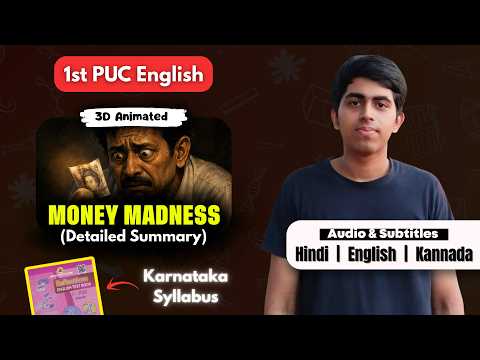
Detailed Summary Video
Money Madness | 3D Animated Detailed Summary | 1st PUC Karnataka Board
D. H. Lawrence’s "Money Madness" is a sharp social critique of the modern world's preoccupation with wealth. The poet asserts that money is not just a personal obsession but a "vast collective madness" of the entire human race. He argues that since the multitude (the society) is mad, every individual inevitably carries a "grain of insanity" regarding money.
The poet describes the physical and emotional pain people feel when parting with money. He observes that almost no one can hand out a pound note without feeling a "pang" of regret, and handing out a ten-pound note causes a "real tremor." This reaction shows that money has gained a "fearful cruel power" over human beings. Instead of money serving humans, humans have begun to "quail" and "grovel" before it in "strange terror."
Society, contempt and a radical solution
Furthermore, the poet clarifies that we aren't just afraid of money itself, but of the "collective money-madness" of our fellow men. Society judges a person's worth based on their bank balance. The world asks, "How much is he worth?" If a man has no money, the world treats him with contempt, saying, "Let him eat dirt, and go cold." While society might give a penniless man a little bread to prevent him from dying, it makes him suffer the humiliation of "eating dirt" (experiencing extreme degradation) along with it.
The poet confesses that this fear of social humiliation is so intense it can become a "delirium." To save ourselves from this fate, we feel forced to have money. However, the poet argues that this entire system is "all wrong." He proposes a radical solution: essential life requirements, bread, shelter, and fire, should be free for everyone in the world. He concludes with a warning: humanity must "regain our sanity" about money before we begin "killing one another about it." We must choose between reclaiming our humanity or facing total destruction.