Nose versus Eyes
by William Cowper
Rapid Learn 2-Minute Revision
Perfect for last-minute revision
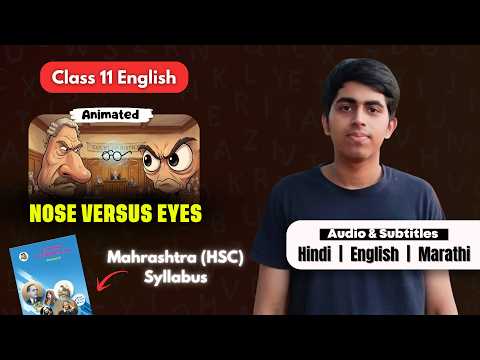
'Nose versus Eyes' is a witty satire on the judicial system. A strange contest arises between the Nose and the Eyes over which of them should own a pair of spectacles. In a mock trial, Tongue acts as the lawyer, arguing skilfully 'with a wig full of learning', while Chief Baron Ear sits as the judge, famed for 'nicely discerning'. Tongue argues in favour of the Nose: the Nose has always worn spectacles ('possession time out of mind'), the spectacles are made with a 'straddle' to sit on the Nose like a saddle, and without a Nose no one could wear them at all. When Tongue then argues for the Eyes, his points seem less wise. So the judge decrees, firmly and without doubt, that whenever the Nose puts the spectacles on, by daylight or candlelight, the Eyes should be shut! The poem humorously mocks blind, illogical justice and the lack of common sense and empathy.
Detailed Summary
Detailed Summary Video
Video coming soon
'Nose versus Eyes' by William Cowper is a humorous satire that mocks the judiciary and the absurdity of blind, one-sided justice. Through a comic courtroom quarrel between parts of the human face, the poet exposes how clever argument can triumph over fairness and common sense.
A strange contest and a mock trial
A 'strange contest' arises between the Nose and the Eyes: to whom should a pair of spectacles rightly belong? The matter goes to court. Tongue serves as the lawyer, arguing the case 'with great deal of skill, and a wig full of learning', while Chief Baron Ear presides as the judge, famed for his talent in 'nicely discerning'.
The clever arguments for the Nose
Tongue argues eloquently in favour of the Nose. First, the Nose has always worn spectacles, which amounts to 'possession time out of mind'. Second, holding the spectacles up, he shows they are 'made with a straddle as wide as the ridge of the Nose', designed to sit close to it 'just like a saddle'. Third, he asks: if a face had no Nose, who could wear spectacles at all? He concludes that the spectacles were plainly made for the Nose, and the Nose intended for them.
An absurd, blind verdict
Then, 'shifting his side, as a lawyer knows how', Tongue pleads for the Eyes, but his arguments are weak and few people even remember them, for the court did not think them 'equally wise'. So the judge decrees, 'with a grave solemn tone, decisive and clear, without one if or but', that whenever the Nose puts the spectacles on, by daylight or candlelight, the Eyes should be shut!
The ridiculous verdict, which robs the Eyes of the very spectacles meant to help them see, satirises a justice system that lacks logic, empathy and common sense, and can be swayed by clever rhetoric rather than truth.