
The Last Lesson
by Alphonse Daudet
Rapid Learn 2-Minute Revision
Perfect for last-minute revision
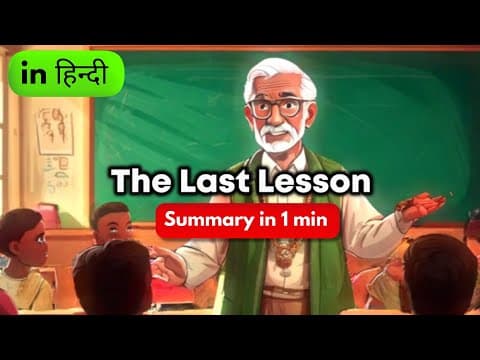
Set in the days of the Franco-Prussian War (1870–71), the story is narrated by Franz, a reluctant French schoolboy in Alsace. Dreading a scolding for not learning his participles, Franz reaches school late to find an unusual stillness. M. Hamel, dressed in his fine Sunday clothes, gently announces that an order has come from Berlin to teach only German in the schools of Alsace and Lorraine, this is their last French lesson. The village elders sit on the back benches to honour the teacher and mourn the loss of their language. Franz suddenly regrets neglecting his lessons and finds, to his amazement, that he understands everything perfectly today. M. Hamel blames himself, the parents and the people for not valuing their language, and calls French the most beautiful, clearest and most logical language, saying a people who hold fast to their language hold 'the key to their prison.' As the church clock strikes twelve and the Prussian trumpets sound, an overcome M. Hamel writes 'Vive La France!' on the board and dismisses the class with a gesture.
Detailed Summary
Detailed Summary Video
Video coming soon
The story shows how the imposition of a foreign language on a conquered people awakens in them a sudden, painful realisation of the value of their own mother tongue. Through a single school day it captures themes of language, identity, patriotism and procrastination.
A late start and an unusual quiet
Franz sets out late for school, tempted to skip it because it is a warm, bright day and he has not learnt the rule for participles. Passing the town hall he sees a crowd before the bulletin-board, from where all the bad news of the war had come. Reaching school, he is surprised by the Sunday-morning stillness instead of the usual bustle of desks and repeated lessons, and slips in ashamed before everyone.
The announcement
M. Hamel, kind for once, is dressed in his beautiful green coat, frilled shirt and embroidered black silk cap worn only on inspection and prize days. The back benches are filled with village elders, old Hauser with his primer, the former mayor and postmaster. M. Hamel announces that the order has come from Berlin to teach only German in Alsace and Lorraine; this is their last French lesson and a new master comes tomorrow. The words strike Franz like a thunderclap.
Regret and understanding
Franz is filled with regret for wasted time, for hunting birds' eggs and skipping study, and his books now feel like old friends. Called to recite the participles, he stumbles, but M. Hamel does not scold him. Instead the teacher blames everyone: parents who preferred children work for money, and himself for sending pupils to water his flowers instead of teaching. He praises French as the most beautiful, clearest and most logical language and urges them to guard it, for 'when a people are enslaved, as long as they hold fast to their language it is as if they had the key to their prison.'
The final moment
The lesson continues with grammar, writing (copies reading France, Alsace), history and the little ones chanting their letters. Old Hauser spells with the children, his voice trembling. When the church clock strikes twelve and the Prussian soldiers' trumpets sound, M. Hamel rises, pale and looking very tall. Unable to speak, he turns to the blackboard and writes with all his might 'Vive La France!' Then, leaning his head against the wall, he gestures, 'School is dismissed, you may go.'