
Lost Spring
by Anees Jung
Rapid Learn 2-Minute Revision
Perfect for last-minute revision
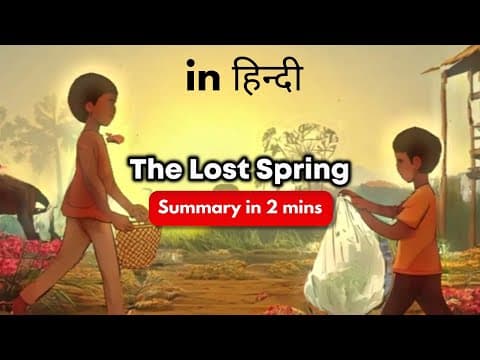
An excerpt from Anees Jung's book 'Lost Spring: Stories of Stolen Childhood', the piece analyses the grinding poverty and traditions that condemn children to a life of exploitation. In the first part, 'Sometimes I find a Rupee in the garbage', the author meets Saheb-e-Alam, a barefoot ragpicker from Dhaka now living in Seemapuri on the outskirts of Delhi. For the 10,000 ragpickers there, garbage is 'gold', their means of survival, while for children it is wrapped in wonder. Saheb later takes a job at a tea stall for 800 rupees, but loses his carefree freedom. In the second part, 'I want to drive a car', the author visits Firozabad, the centre of India's glass-blowing bangle industry, where Mukesh dreams of becoming a motor mechanic. Whole families spend generations welding glass in dark, hot furnaces, often losing their eyesight, trapped in a vicious circle of poverty, caste stigma, sahukars, middlemen, policemen and politicians. Mukesh alone dares to dream of a different life.
Detailed Summary
Detailed Summary Video
Video coming soon
The essay exposes the harsh reality of child labour and the 'stolen childhood' of the poor. It juxtaposes the innocent dreams of children against the crushing weight of poverty and tradition that forces them into exploitative work.
Saheb and the ragpickers of Seemapuri
Saheb-e-Alam, whose name ironically means 'lord of the universe', scrounges for 'gold' in the garbage dumps. His family fled the storms and poverty of Dhaka and settled in Seemapuri, a settlement of 10,000 ragpickers living without identity or permits but with ration cards. For the children garbage holds wonder (the chance of finding a rupee or a coin), while for elders it is a means of survival. Saheb watches boys play tennis behind a fence and wears discarded tennis shoes with a hole, content with even that.
The loss of freedom
Later Saheb takes a job at a tea stall, earning 800 rupees and all his meals. But he has lost his carefree look: the steel canister he now carries belongs to the shop owner, unlike the plastic bag that was his own. Saheb is 'no longer his own master', the price of a small wage is his freedom.
Mukesh and the bangle-makers of Firozabad
In Firozabad, the centre of India's glass-blowing industry, every other family makes bangles. About 20,000 children work illegally in dingy, hot furnaces, welding glass in dim light and often losing their eyesight before adulthood. Families believe it is their god-given lineage and karam (destiny). They live in stinking lanes and crumbling homes, and even a full meal is a luxury, the old woman has 'not enjoyed even one full meal in her entire lifetime.'
The vicious circle and a lone dream
The bangle makers are trapped in a vicious circle of sahukars, middlemen, policemen, bureaucrats and politicians, and dare not organise into a cooperative for fear of the police. Years of mind-numbing toil have killed their ability to dream. Only Mukesh dares to be different: he wants to be a motor mechanic and learn to drive a car, willing to walk a long way to a garage, a small but real flash of hope in a hopeless world.